
How to Find Phone Numbers in New York
Most failed phone searches in New York start at the wrong level of government. About 20 million people live here, spread across 62 counties and thousands of cities, towns, and villages, and every layer publishes its own numbers. Permits, streets, and trash pickup belong to your municipality. Social services, public health, the clerk, the sheriff, and elections belong to the county. Driver licenses, unemployment, utility complaints, and State Police belong to the state. Robocalls and numbering questions belong to federal agencies. Pick the layer first and the right directory is usually one click away.
The statewide starting point is the NY.gov phone directory. It is organized by agency heading, and each row carries a contact name or a general-information label, a job title, a direct office phone, and a link to that agency's own contact page. Rows pulled from it include the Department of Veterans' Services general line at 518-474-6114, the Office for the Prevention of Domestic Violence at 518-457-5800, the Office of Indigent Legal Services at 518-486-2028, and the Office for the Aging at 1-844-697-6321.
The page has no filter form of its own, which surprises people who expect a search box. You browse the agency headings or use the site search.
| Field | Type | Required | Notes |
|---|---|---|---|
| NY.gov site search | Text | No | Searches the whole state website, not just the directory |
| Agency heading | Browse heading | No | Agencies and offices are listed alphabetically down the page |
| Contact | Row text | n/a | A named official, or a label such as General Information |
| Title | Row text | n/a | Commissioner, general counsel, public information officer, and so on |
| Phone Number | Row text | n/a | Direct office line or the agency main number |
| Agency Contact URL | Link | n/a | Resident-facing contact page where the agency publishes one |
Here is an order that saves time on most New York phone number searches.
- Check the state directory first if the office is a state agency, since it carries direct lines rather than a switchboard.
- Go to the county website for social services, health, the county clerk, the sheriff, and the board of elections.
- Go to the city, town, or village site for permits, the clerk, public works, and local police non-emergency lines.
- Dial 211 anywhere outside New York City when you cannot tell which office handles a human-services need.
- File a FOIL request with the agency records access officer when the number you want is not published anywhere.
Note: staff cell numbers, internal extensions, and law enforcement personal contacts are not public directory material and are routinely withheld from FOIL responses.
Area Codes Serving New York
New York is not a one area code state. The 1947 numbering plan gave it five: 212 for New York City, 315 for the central and north-central counties, 518 for the east and northeast, 716 for the west, and 914 for the lower Hudson Valley and Long Island. Growth broke those five territories apart. Today more than twenty codes are in service, grouped into regional complexes, and the newest ones share ground with older codes instead of carving up the map.
The table below groups the codes the way New Yorkers actually think about them, by region rather than by assignment date.
| Area Code | Coverage | Year Assigned | Overlay Status |
|---|---|---|---|
| 212, 646, 332, 917 | Manhattan, with 917 assigned across the whole city | 1947, 1999, 2017, 1992 | 212 original, the rest overlay the same ground |
| 718, 347, 929, 465, 917 | Bronx, Brooklyn, Queens, Staten Island, Marble Hill | 1984, 1999, 2011, 2026, 1992 | 718 split from 212, the rest overlay it |
| 516, 363 | Nassau County | 1951, 2023 | 516 split from 914, 363 overlays it |
| 631, 934 | Suffolk County | 1999, 2016 | 631 split from 516, 934 overlays it |
| 914 | Westchester County | 1947 | Original code, no overlay |
| 845, 329 | Dutchess, Orange, Putnam, Rockland, Sullivan, Ulster and nearby | 2000, 2023 | 845 split from 914, 329 overlays it |
| 518, 838 | Albany, Schenectady, Troy, Saratoga Springs, Plattsburgh, Lake Placid | 1947, 2017 | 518 original, 838 overlays it |
| 315, 680 | Syracuse, Utica, Rome, Watertown, Oswego | 1947, 2017 | 315 original, 680 overlays it |
| 716, 624 | Buffalo, Niagara Falls, Tonawanda, Jamestown, Olean | 1947, 2024 | 716 original, 624 overlays it |
| 585 | Rochester, Batavia, Wellsville, western Finger Lakes | 2001 | Split from 716, no overlay |
| 607 | Binghamton, Elmira, Ithaca, Corning, Oneonta | 1954 | Split from 315 and 716, no overlay |
Ten digits are the safe rule everywhere in the state now. Overlay regions have required the area code on local calls for years, and the national move to 988 in October 2021 finished off seven-digit dialing in the areas that still allowed it. Calls to another area code take 1 plus the ten digits. County by county detail sits on the New York area codes page.
Public Safety Phone Numbers in New York
Three digits handle most urgent calls, and picking the right three matters. Dial 911 when someone is in danger right now. Dial 988 for a suicide, mental health, or substance-use crisis that is not a physical emergency. Dial 211 for housing, food, heating help, and other human services, unless you are in New York City, where 311 does that job. Routine city complaints never belong on 911.
911 - police, fire, or medical emergency anywhere in the state.
988 - Suicide and Crisis Lifeline. Call, text, or chat, 24 hours a day.
311 - non-emergency New York City services. From outside the city, VoIP, TTY, or VRS, use 212-639-9675.
211 - community services outside New York City through regional providers such as 211 WNY at 888-696-9211.
Poison Control - 1-800-222-1222, around the clock.
Specialized hotlines run alongside those, and most people never learn them until the day they need one. Each is statewide unless noted.
- Child abuse or maltreatment - 1-800-342-3720, with TDD at 1-800-638-5163 and a separate mandated reporter line at 1-800-635-1522
- Adult Protective Services - 1-844-697-3505 for elder and vulnerable adult abuse, 8:30 a.m. to 8 p.m. weekdays
- Domestic and sexual violence - 1-800-942-6906, or text 844-997-2121, confidential and available in most languages
- National Domestic Violence Hotline - 1-800-799-7233
- RAINN sexual assault hotline - 1-800-656-4673
- Office of Victim Services - 1-800-247-8035, weekdays 9 a.m. to 5 p.m.
- OASAS HOPEline - 1-877-846-7369 for substance use and problem gambling, or text HOPENY
Outside the cities, the New York State Police answer many non-emergency calls, and they route by troop rather than by one statewide number. The State Police contact page lists which counties each troop covers. Troop A takes western counties at 585-344-6200, Troop B covers the North Country at 518-897-2000, Troop C covers the Southern Tier at 607-561-7400, and the New York City troop lists stations such as Manhattan at 212-459-7800 and Brooklyn at 718-625-2584.
New York Municipal Phone Directories
There is no single city hall for New York State, so municipal numbers come from whichever city, town, or village you live in. New York City is the deepest example by far, and its system is worth understanding even if you live four hundred miles away, because so many other municipalities copy pieces of it.
NYC311 runs 24 hours a day by phone, web, text, and app. Dial 311 inside the five boroughs. From outside the city, from a VoIP line, or through TTY and VRS, the number is 212-NEW-YORK, which dials as 212-639-9675. The text channel is 311-692. Interpretation is offered in most languages, and the text service is translated into several. You can see the entry points on the NYC311 portal.
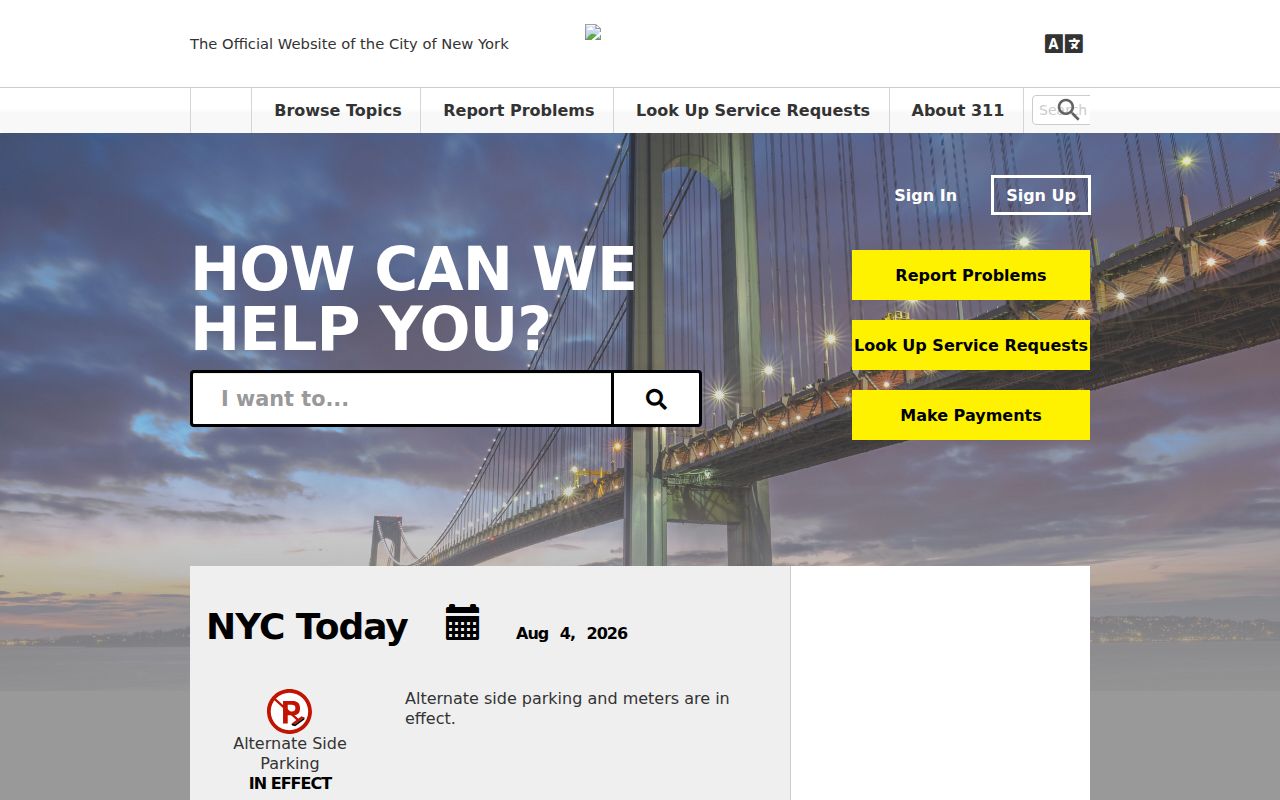
Search, browse topics, report a problem, look up a request you already filed, and pay a city bill all start from that one screen, which is why residents use it instead of hunting for agency numbers.
The NYC agency directory is a different tool. It lists agencies, offices, boards, and commissions with their leaders and contact pages. It is not a person by person staff phone book, so treat it as the way to reach the right office rather than the right desk. Everywhere else in the state, the equivalent is the clerk's office, and the county website is the backup when the municipal site is thin.
NYC311 City Services
Dial 311 in the five boroughs
Outside the city: 212-639-9675
Open 24 hours, every day
Phone, web, text to 311-692, and app
NYC Department of Buildings
Permits, inspections, complaints
Phone lines 8:30 a.m. to 4:30 p.m. weekdays
212-566-5000
Complaints route through 311
Governor's Office
NYS State Capitol Building
Albany, NY 12224
518-474-8390
Constituent services by phone, form, or mail
Note: municipal directories list office phones only, and a clerk can correct a listing that has gone stale on the town website.
County and State Numbers Serving New York
County government owns a long list of services that residents call about constantly. County clerks handle deeds, local records, and passport counters, and in many counties they also run the DMV office. Boards of elections handle voter registration. Departments of social services handle SNAP, Temporary Assistance, Medicaid processing, child welfare, and heating help. Sheriffs handle jail information and the civil division. Offices for the aging handle senior services. None of that routes through Albany, so the county site is the faster stop.
Public health is the easiest county layer to search, because the county health official directory collects every county health department in one place with phones, faxes, and website links.
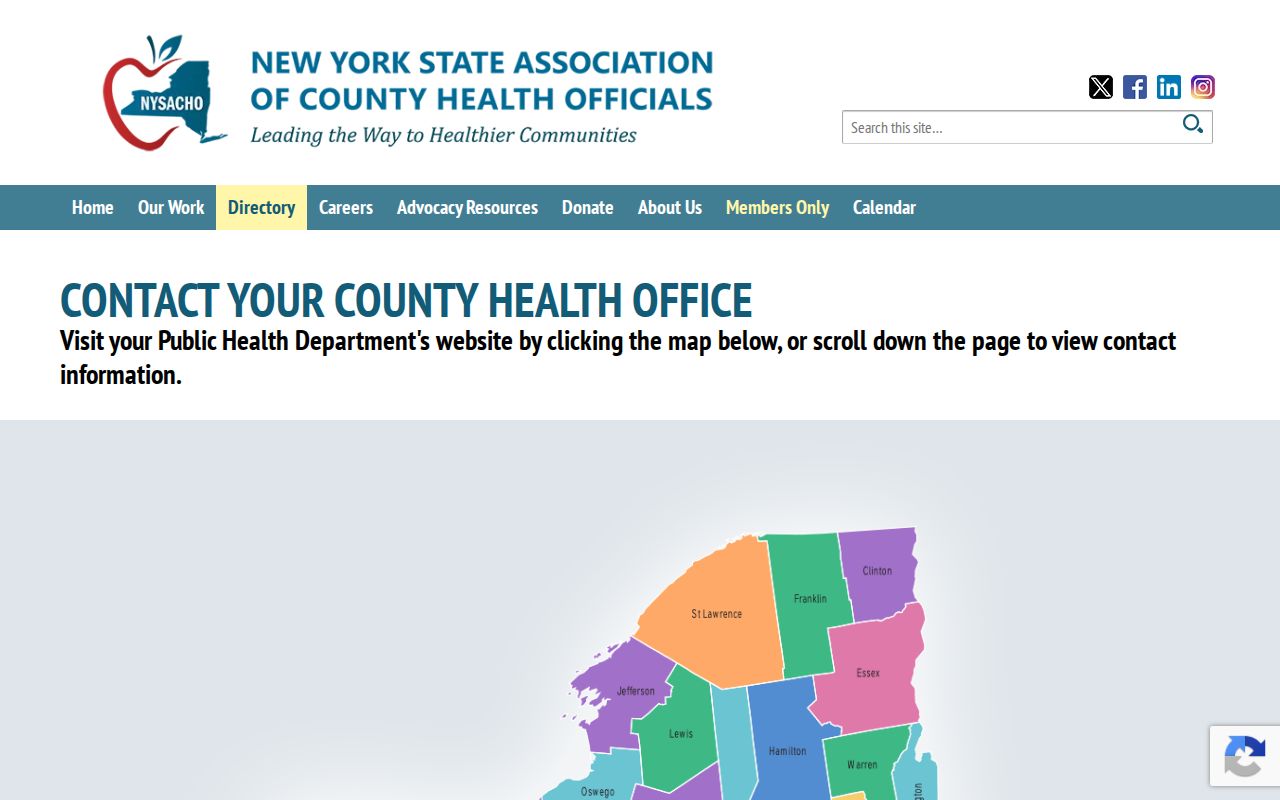
Entries there include Albany County at 518-447-4580, Clinton County at 518-565-4840, Rockland County at 845-364-2513, Schenectady County at 518-386-2824, and Rensselaer County at 518-270-2655 with an after-hours emergency line at 518-857-4660.
State agency lines cover the rest. The DMV call center answers at 800-698-2931 on weekdays from 8 a.m. to 4 p.m., with road test scheduling at 518-402-2100 around the clock and the Title Services Bureau at 518-486-4714. Unemployment claims go to the Telephone Claims Center at 888-209-8124. Income tax questions go to 518-457-5181. Utility and telephone complaints go to the Department of Public Service at 1-800-342-3377. Benefit programs go to 1-800-342-3009. Emergency management in Albany answers at 518-242-5000.
New York School, Campus, and Library Directories
Education is one of the strongest directory layers in the state, because the agencies, the public college systems, and the library systems all publish contact records. The State Education Department contact page is the front door, with general information at 518-474-3852. Teacher certification and TEACH account problems go to 518-474-3901. Fingerprinting is 518-473-2998. The high school equivalency office answers at 518-474-5906, and ACCES-VR runs on 1-800-222-5627.
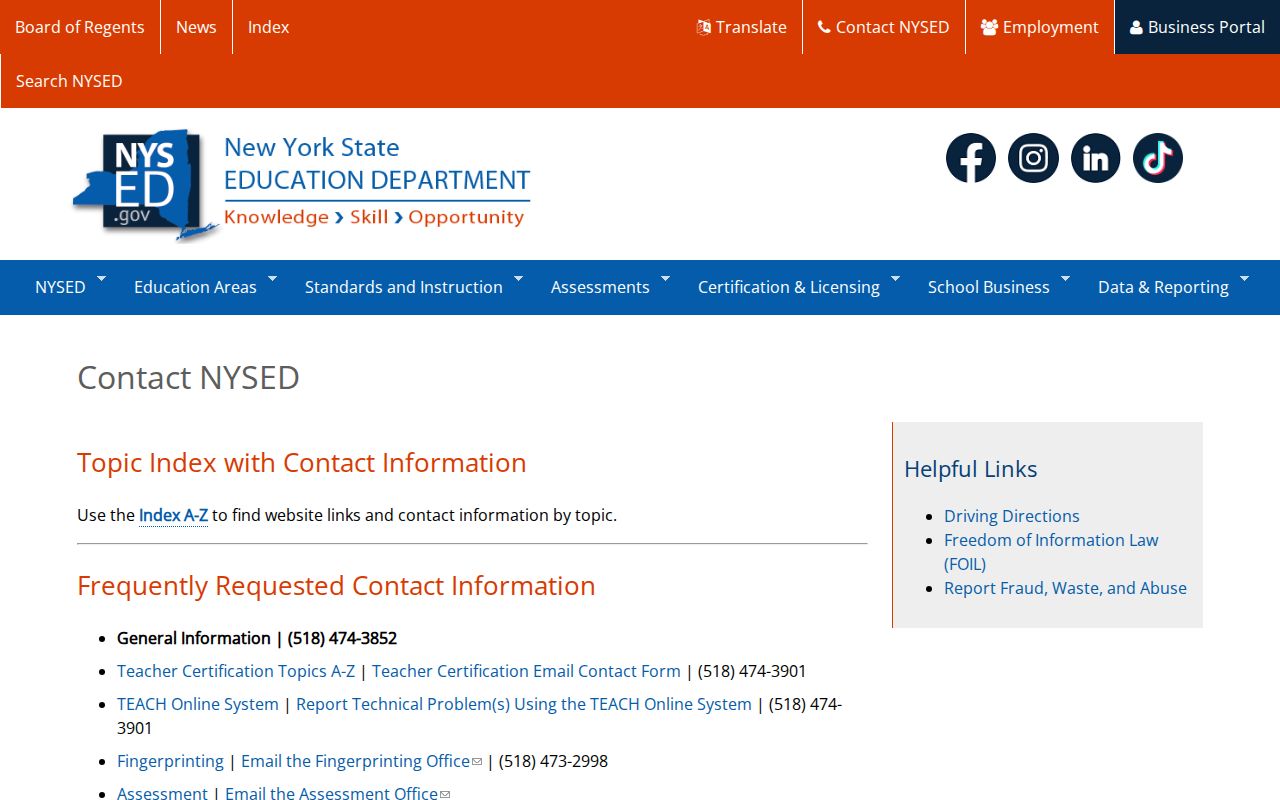
When a local district site has no staff list at all, the department's data support desk at 518-474-7965 maintains the official directory of public and nonpublic schools and administrators.
K-12 practice varies enormously. New York City Public Schools alone serves about 1.1 million students in more than 1,800 schools, and its help line answers at 718-935-2200 on weekdays from 8 a.m. to 6 p.m., with 311 covering education questions after hours, TTY at 212-504-4115, and over the phone interpretation in more than 200 languages. School office numbers are public, so P.S. 005 Ellen Lurie in Manhattan lists 212-567-8109 and P.S. 001 Courtlandt School in the Bronx lists 718-299-3700. Teacher direct lines usually are not published.
- SUNY - system administration at 518-320-1100, toll-free at 800-342-3811, with an employee directory that reaches campus listings
- CUNY - campus by campus telephone and email directories, including Hunter and BMCC
- New York Public Library - 917-275-6975, Monday through Saturday, in English and Spanish, with text at 917-983-4584
- Brooklyn Public Library - 718-968-7275 by phone, chat, email, or in-person appointment
Public libraries are the quiet workhorse of local information, and the state keeps a full public library directory covering every library in New York.
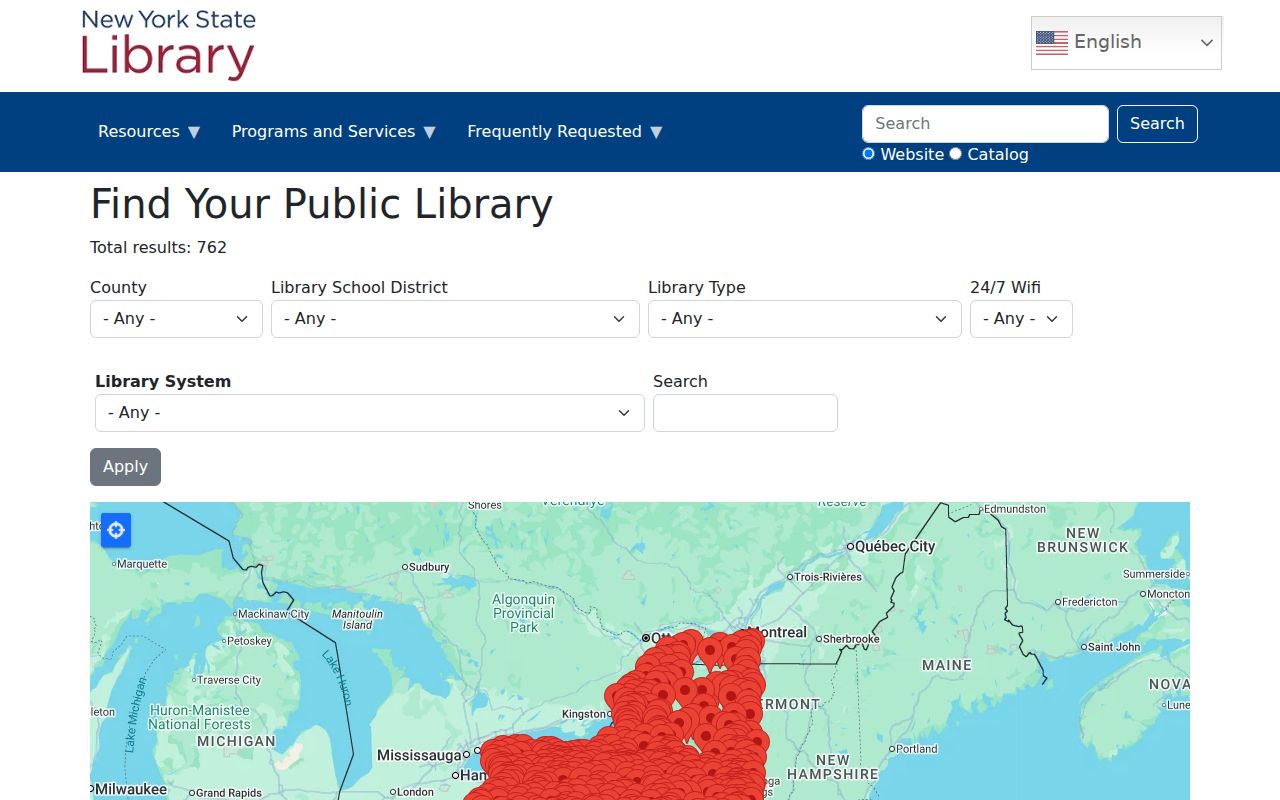
Each record shows the library name, its address, the county, the library system it belongs to, the school district it sits in, and whether Wi-Fi runs around the clock.
New York Utility Phone Numbers
Utility service depends on your address, not your county, so the provider changes as you move across the state. What does not change is the split between emergency lines and customer service lines. Mixing those two up is the most common mistake residents make. A gas odor is never a billing call.
| Utility or Need | Emergency or Outage | Customer Service |
|---|---|---|
| Con Edison, New York City and Westchester | 911 or 1-800-752-6633 for gas and electric, 1-800-914-9112 for steam | 1-800-752-6633 |
| National Grid, upstate | Gas 1-800-892-2345 or 911, electric outage 1-800-867-5222 | 1-800-642-4272 |
| NYSEG | Gas 800-572-1121 or 911, electric 800-572-1131 | Through the provider account page |
| RG&E, Rochester region | Gas 800-743-1702 or 911, electric 800-743-1701 | Through the provider account page |
| PSEG Long Island | 1-800-490-0075 | 1-800-490-0025, Spanish 1-800-490-0085 |
| National Fuel, western New York | 1-800-444-3130, 24 hours | 716-686-6123 in the Buffalo area, 1-800-365-3234 elsewhere |
| Digging or excavation | Dial 811 before you dig, several days ahead | |
When the provider will not fix the problem, the state regulator steps in. The Department of Public Service takes gas, electric, water, telephone, and cable complaints at 1-800-342-3377 on business days from 8:30 a.m. to 4 p.m. Service that has been shut off, or is about to be, has its own hotline at 1-800-342-3355, staffed from 7:30 a.m. to 7:30 p.m. on business days. Complaints about an energy supplier rather than the utility itself go to 1-888-697-7728.
Health and Social Services Numbers in New York
The Department of Health runs the widest set of health lines in the state. Its contact page carries a public health emergency helpline at 1-866-881-2809 for nights and weekends, including communicable disease reports, along with a general information line at 1-833-364-4695 and WIC at 1-800-522-5006.
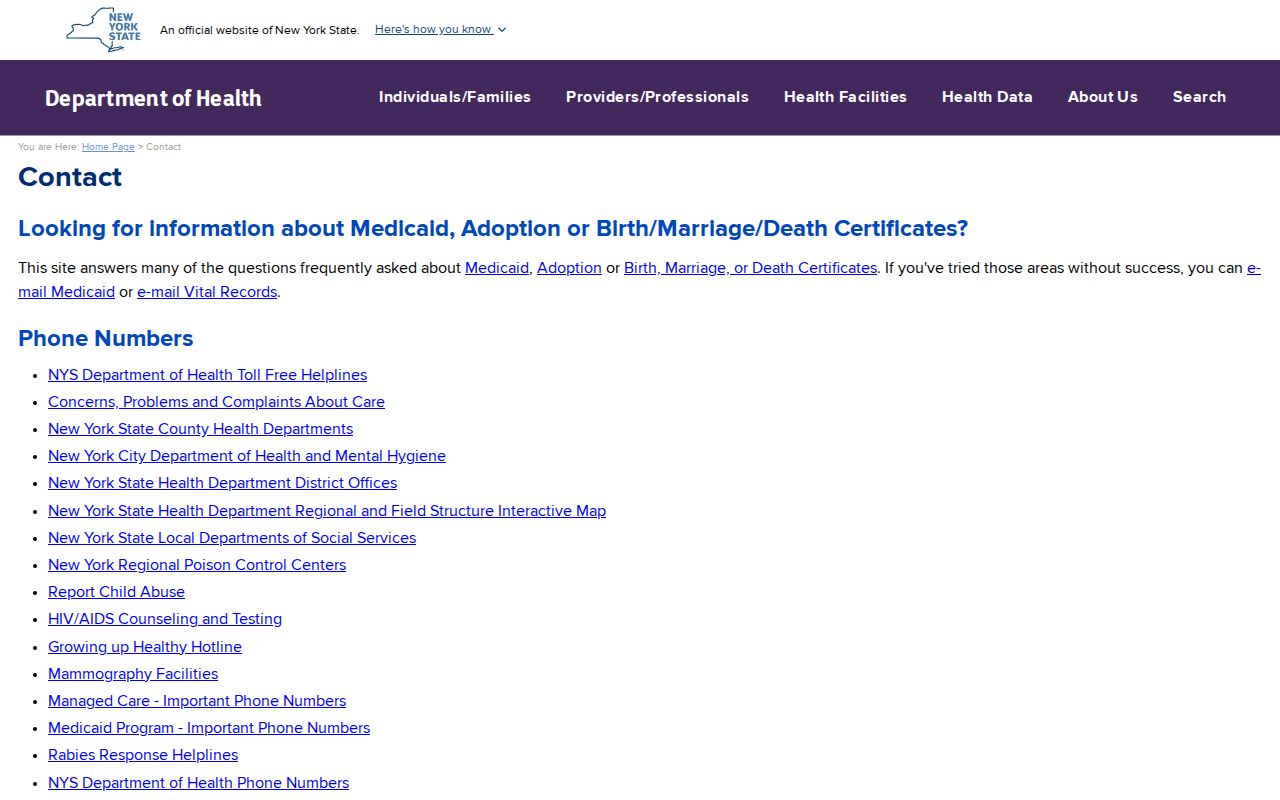
The department also publishes a division-level phone directory, which is the tool to use when you need a program office rather than the main switchboard.
Benefits work differently. SNAP, heating assistance, and Temporary Assistance questions go to 1-800-342-3009, and Fair Hearing requests go to 1-800-342-3334, with a New York City emergency hearing line at 1-800-205-0110 and a relay path for hearing impaired callers who dial 711 and ask for 1-877-502-6155. Eligibility interviews and documents still run through the county social services district, so the local office phone is the one you will actually use most.
Older adults and caregivers have their own front door. NY Connects and the Office for the Aging answer at 1-844-697-6321 for long-term services and supports. Hospital systems publish their own switchboards, including New York City Health + Hospitals at 1-844-692-4692, NYU Langone at 646-929-7800, and NewYork-Presbyterian appointments at 877-697-9355.
Court and Legal Phone Numbers in New York
Court numbers are local, not statewide. Clerk phones change by county, by city, town, and village, and by court type, so the Unified Court System site and its court finder are the correct starting point rather than any single courthouse line.
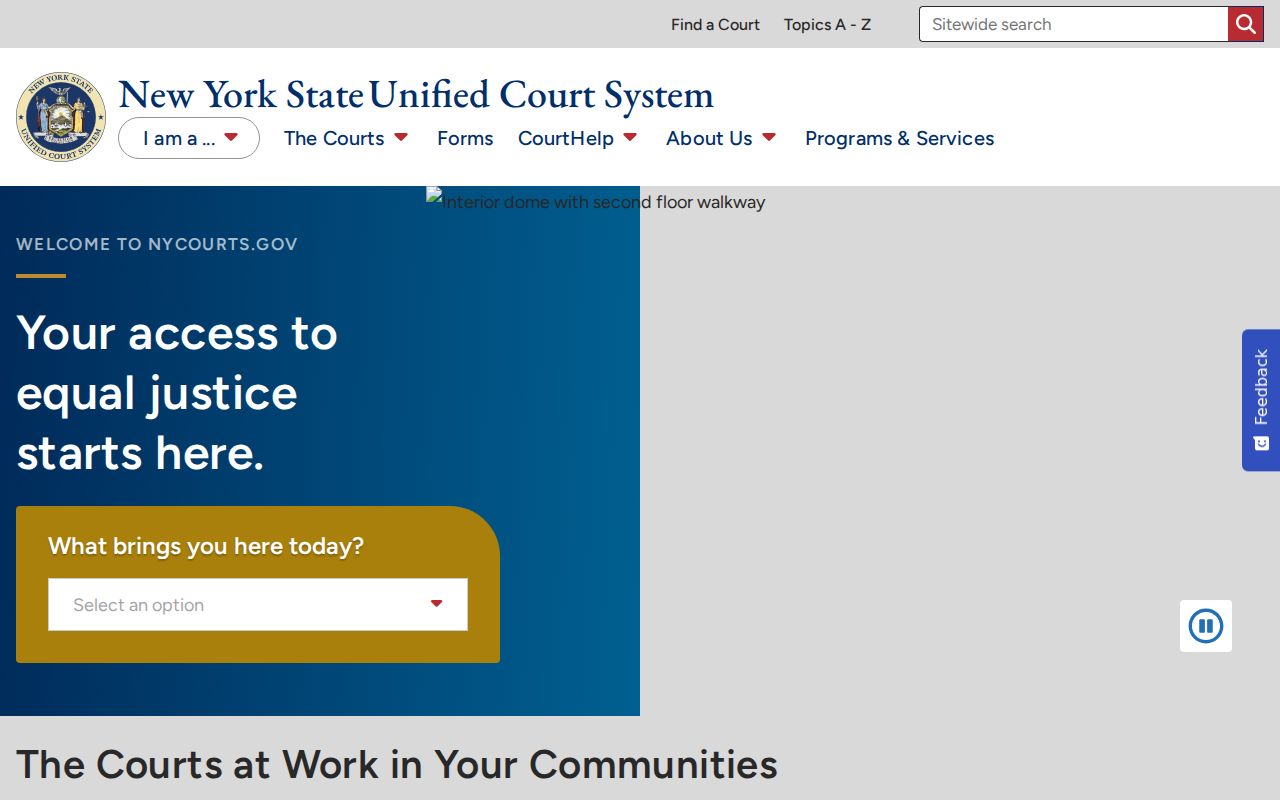
The finder asks what brings you in, then filters by court type and county, with a switch that adds town and village courts to the results.
Legal help splits by need. The Attorney General runs a general helpline at 1-800-771-7755, a deaf and hard of hearing line at 1-800-788-9898, and a health care helpline at 1-800-428-9071. The Office of Indigent Legal Services answers at 518-486-2028, though the actual defense office is county based. In New York City, the Legal Aid Society main number is 212-577-3300, and the City Bar legal referral service answers at 212-626-7373, with Spanish at 212-626-7374. District attorney offices are county offices, so Manhattan lists 212-335-9000 and Brooklyn runs an action center at 718-250-2340.
Looking Up an Unknown New York Number
Start with what can actually be verified. An area code tells you where a number was first assigned. The three digits after it, the NXX, point at the original rate center and the carrier that got the block. Neither one proves where the caller is sitting today. Numbers move between carriers and follow people out of state, and a 212 or 716 caller ID can be spoofed by anyone with cheap software. Official tools answer narrow questions well. Commercial tools guess at names and spam reputation, and they are the ones asking for money.
| Tool | Type | What It Returns |
|---|---|---|
| NANPA area code maps and reports | Official | Whether a code is real and which region it covers |
| NANPA central office code records | Official | Original NPA-NXX assignment, carrier, and rate center |
| NY.gov phone directory | Official | The real number for a state office a caller claims to represent |
| FCC Consumer Complaint Center | Official | A complaint record, not a caller name |
| NumLookup, Truecaller, YouMail | Third-party | Claimed name, carrier, line type, spam reputation |
| Carrier apps | Carrier | Spam and fraud labels on your own line |
If a caller claims to be a state agency, hang up and dial the published number instead. The full routine, official channels first, sits on the New York phone numbers page.
Scam Calls and How to Report Them
A local looking number proves nothing at all. Spoofing a New York area code costs a scammer almost nothing, and VoIP numbers are easy to get in bulk. The scripts that hit New Yorkers hardest are government impostors claiming to be the IRS, Social Security, Medicare, a court, or a sheriff, utility shutoff threats using the Con Edison, National Grid, NYSEG, PSEG, or National Fuel name, jury duty warrants demanding gift cards or crypto, grandparent emergencies now built with cloned voices, health insurance and Medicaid renewal calls fishing for a Social Security number, and the usual warranty and debt relief robocalls.
Where you report depends on what happened. Telemarketing that ignores the registry goes to the FTC unwanted call report page or 1-888-382-1222. Spoofing, blocked calls, and provider problems go to the FCC Consumer Complaint Center or 1-888-225-5322.
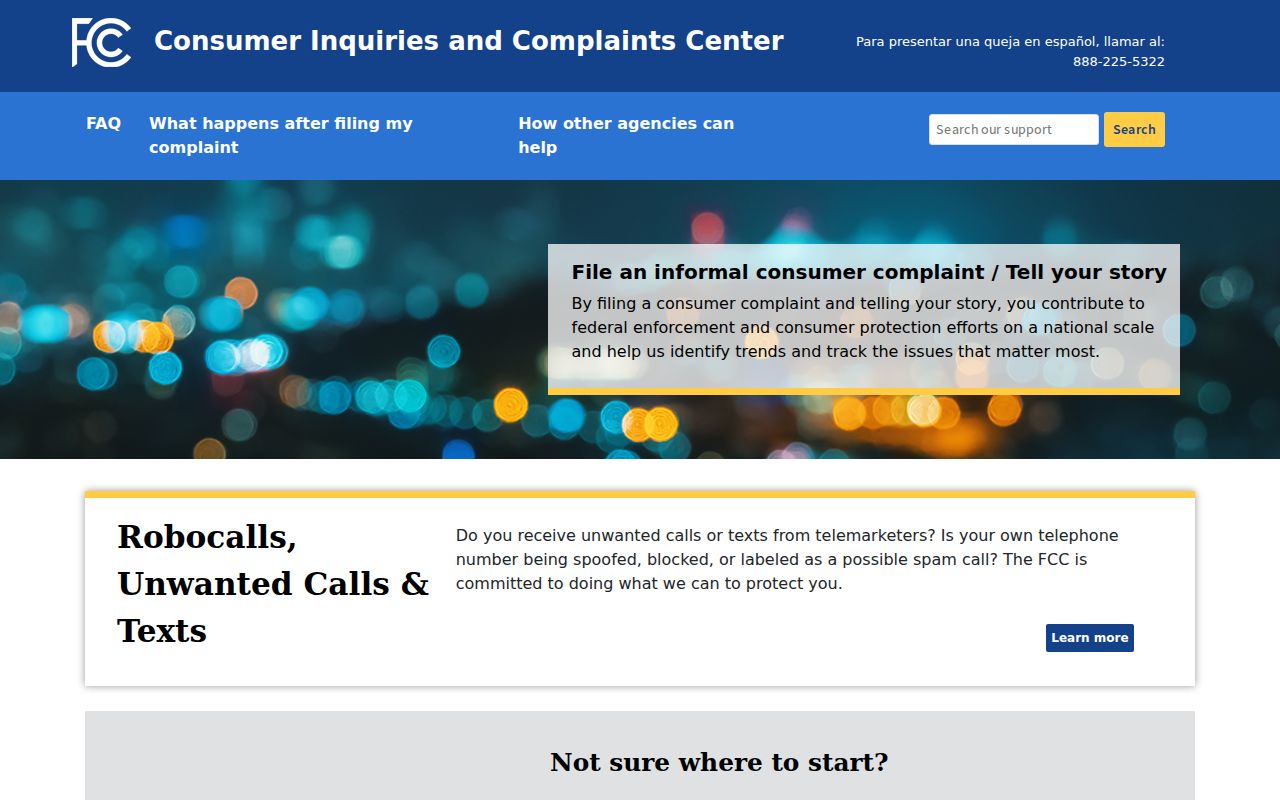
The form walks you through issue categories, and unwanted calls, texts, and number spoofing each have their own path.
A business or impostor targeting New Yorkers goes to the Attorney General at 800-771-7755. Anything involving a regulated phone, cable, or energy company goes to the Department of Public Service at 1-800-342-3377. If you lost money or were threatened, call your local police non-emergency line too.
Community Phone Resources in New York
Outside New York City, 211 is the most useful non-emergency number in the state. It runs 24 hours a day, every day of the year, and regional providers cover their own counties. In western New York you can dial 211, call 888-696-9211, or text your ZIP code to 898211, and hard of hearing callers dial 711 and ask for the toll-free line. The Southern Tier and Finger Lakes helpline lists 211 or 1-800-346-2211. Inside the five boroughs, 311 handles the same kinds of requests, which is why New York City has no separate 211 provider.
The 211 WNY contact page shows how many ways one regional provider can be reached.
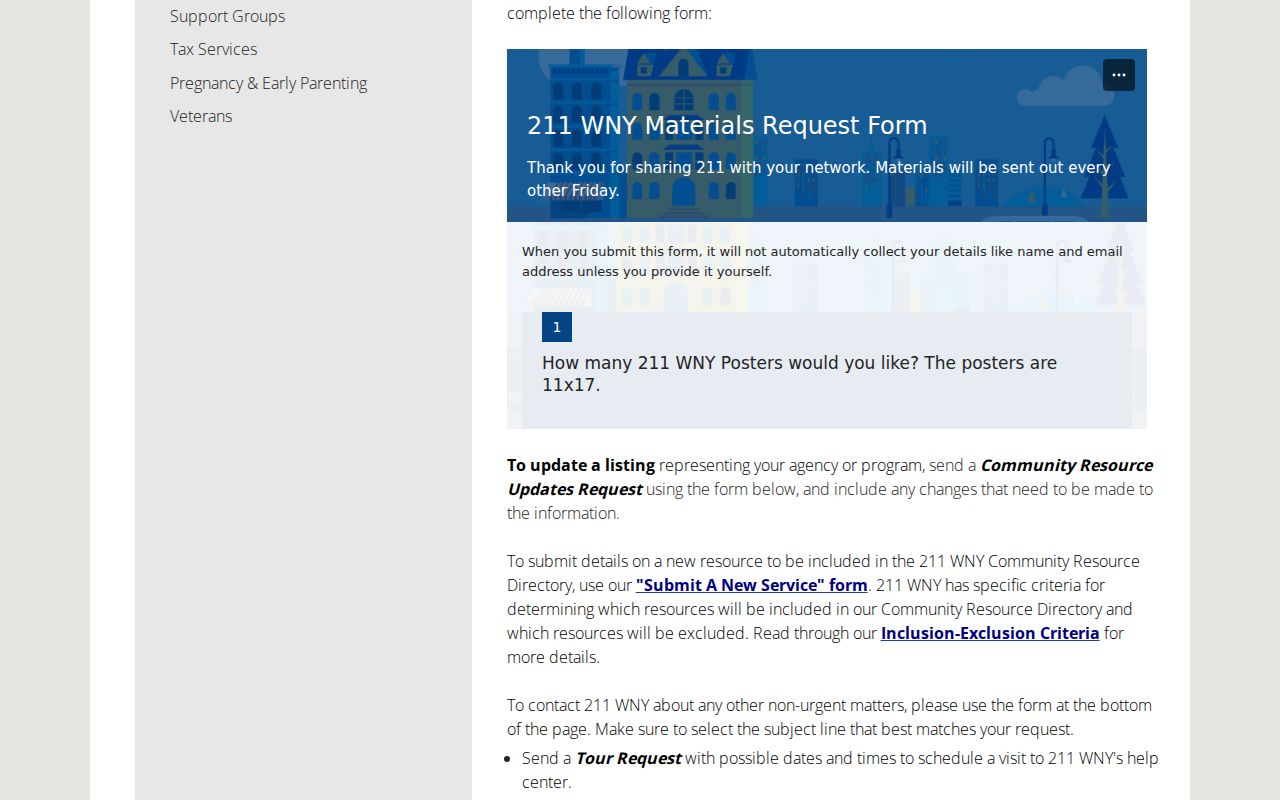
Phone, text, relay, callback, and a form for updating a listing all sit on one page, and other regional providers follow the same pattern.
A few more statewide numbers are worth keeping. NY Connects covers aging and disability services at 1-844-697-6321. Travel and transit information runs on 511 through the state travel service. Library systems are the local layer underneath all of it, and the public library systems page shows how the branches are grouped.
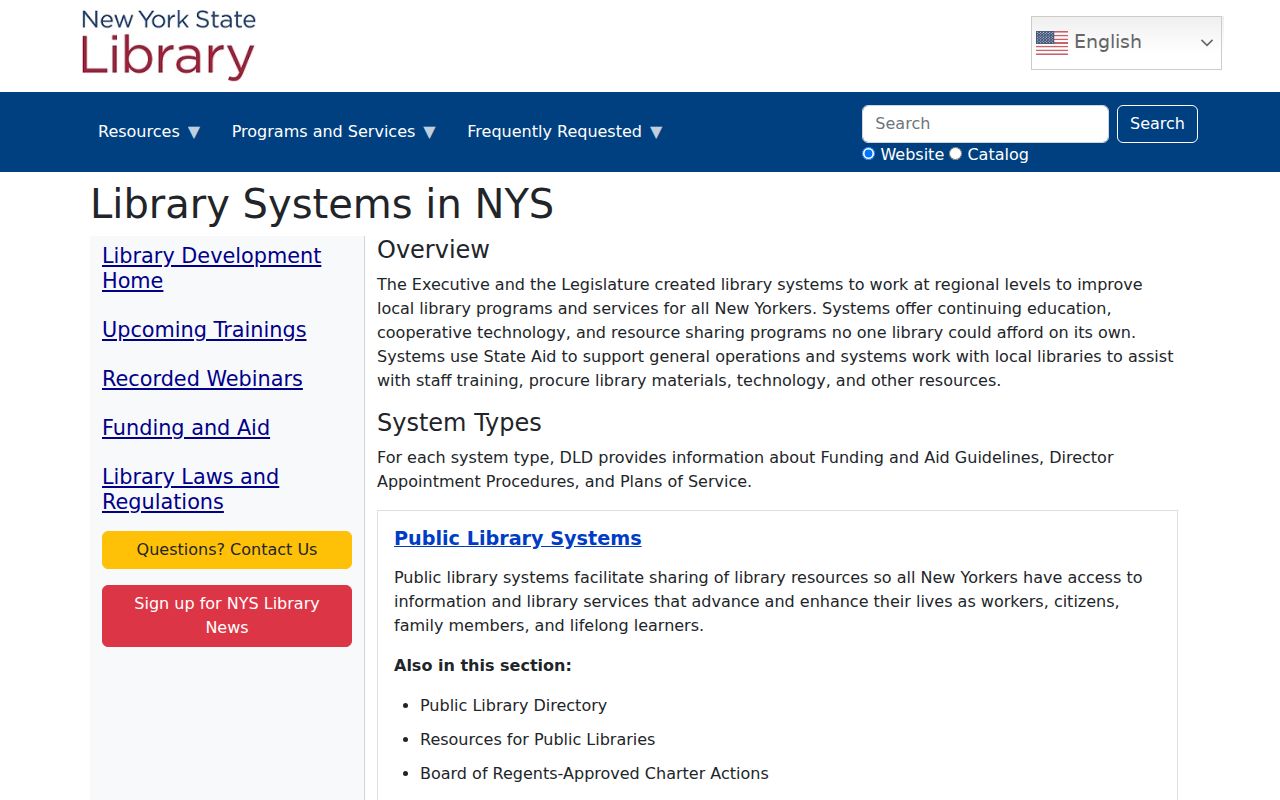
Branch staff field an enormous number of questions about benefits, forms, computer access, and where to call next, which makes the nearest library a real phone resource.
Phone Numbering Basics for New York
Every New York number has the same shape: three digits for the area code, three for the exchange, four for the line. Local calls take all ten. Long distance inside the country takes 1 plus the ten. International calls take 011, the country code, then the number, though a mobile phone accepts a plus sign instead. The rest of the dialing landscape, including the star codes and the three-digit service codes, sits on the New York phone codes page.
- NPA
- Numbering Plan Area, the three-digit area code.
- NXX
- Central office code, the three digits after the area code.
- NANP
- North American Numbering Plan, the +1 region that covers New York, the rest of the country, Canada, and other territories.
- Overlay
- A second or third area code laid over the same ground. Nobody changes numbers, and everyone dials ten digits.
- Split
- A new area code carved out of part of an old territory. People in the new part get new numbers.
- Rate Center
- The billing geography a prefix belongs to, such as a Manhattan or Syracuse zone.
Phone Service History in New York
New York City was one of the first and most important telephone markets in the country, and the local company lineage runs straight through it: New York Telephone became part of NYNEX, then Bell Atlantic, then Verizon. Old central office records still list Verizon New York as the original assignee on a great many prefixes.
Area code 212 turned into a status symbol along the way. It covered the whole city at first. In 1984 the 718 split pulled Brooklyn, Queens, and Staten Island away, with permissive dialing running from September 1984 into January 1985, and the Bronx moved later. Then 917 arrived in 1992 for citywide and mobile use, and 646, 347, 929, 332, and 465 followed as overlays. Upstate has its own identities. 716 means Buffalo, 585 means Rochester, 518 means Albany and the Adirondacks, 315 means Syracuse and Utica, and 607 means the Southern Tier and college towns like Ithaca.
Before all-number calling, New Yorkers said their numbers as words. The first two letters of the exchange name stood for the first two digits, which is why PEnnsylvania 6-5000, the Hotel Pennsylvania number made famous by the Glenn Miller song, is still one of the best known phone numbers in the country.
Recent Phone News in New York
The busiest news in New York numbering is area code relief. The Public Service Commission approved an all-services overlay for the 347, 718, 917, and 929 complex, and the numbering administrator set the schedule in planning letter PL-630: customer education and network work beginning in September 2025, earliest code ordering in April 2026, and activation of 465 on June 18, 2026. The commission has said 465 numbers will not be handed out until the existing outer-borough supply runs dry, which it currently projects for the third quarter of 2027.
Western New York is on a similar track. The 624 overlay is approved relief for 716, and the state says 624 numbers get assigned only after the remaining 716 numbers are gone. Two other overlays are already in daily use: 329 joined the 845 region in 2023, and 363 joined Nassau County's 516 the same year. In every one of these cases the commission chose an overlay over a split, because nobody has to give up a number they already have.
Note: Code assignments and dialing plans change, so confirm anything time-sensitive against current NANPA reports and Public Service Commission notices.
Frequently Asked Questions
Do I have to dial ten digits in New York?
Yes, treat ten digits as the rule everywhere. Overlay regions required it long ago, because two or more codes share the same ground and seven digits would be ambiguous. The national 988 transition in October 2021 removed seven-digit dialing in the areas that still allowed it. Calls to a different area code take 1 plus the ten digits. Three-digit service codes such as 911 and 311 are unaffected and still work as three digits.
Which directory covers state employees?
The NY.gov phone directory is the master list for state government. It is organized by agency heading rather than by a search form, and each row shows a contact, a title, a direct phone, and a link to the agency contact page. It covers state-level offices only. County staff, town staff, and school staff are not in it, so for those you go to the county site, the municipal site, or the school district.
Is there a 311 line for all of New York?
No. 311 in New York means New York City, where it runs 24 hours a day by phone, text, web, and app. Other cities may run their own service line under their own name, and many towns and villages have none at all. Where nothing local exists, the clerk's office handles routing during business hours, and 211 covers health and human services anywhere outside the five boroughs.
Can I tell where a caller is from by the area code?
Only roughly, and only about the past. A 212 number was assigned in Manhattan, a 716 number around Buffalo, a 631 number in Suffolk County. Portability broke the link between the code and the person years ago. Someone can move across the country and keep a New York number forever, and scammers deliberately spoof local codes so the call looks like a neighbor.
How do I get a birth or death certificate by phone?
It depends on where the event happened. For most of the state, the Vital Records call center answers at 855-322-1022, and the department will not confirm a record by email. New York City keeps its own records, so those requests go through 311 or 212-639-9675 from outside the city, at $15 per copy, with newborn certificate questions at 646-632-6563. Marriage licenses are handled by the local clerk wherever the license was issued.
Who do I call about a robocall pretending to be a state agency?
Report it to the Attorney General at 800-771-7755, since that office handles impersonation aimed at New Yorkers. File with the FCC Consumer Complaint Center as well, and add the number to the FTC unwanted call reports if it was a sales pitch. Before you file, write down the number that showed on caller ID, the date and time, what the caller demanded, and how they wanted to be paid.